Space and Planetary Sciences

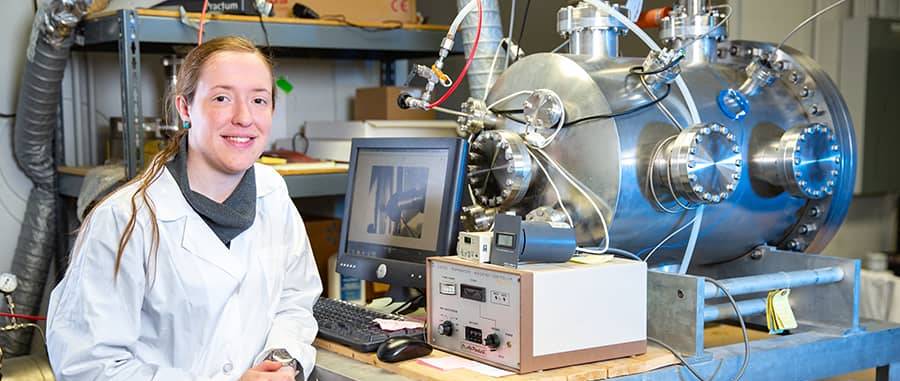
The degree programs in Space and Planetary Sciences encompass interdisciplinary research over a wide range of topics in space science, planetary science, and engineering. This research is conducted within dedicated laboratories and facilities within the various participating departments. Current research interests are water on Mars, astrobiology, atmospheric processes on Venus, ices on Pluto and other ice worlds, planetary geomorphology, galactic and extragalactic astronomy, extreme-temperature electronics, small spacecraft development and operations, remote sensing, and meteorite and impactite analysis.


Program Offerings: Masters and Doctoral Paths

M.S. in Space and Planetary Sciences

At least 24 semester hours of courses plus at least six hours of SPAC 6000V are required for a total of at least 30 hours beyond the baccalaureate degree. View required courses to earn an M.S. in Space and Planetary Sciences. 

Ph.D. in Space and Planetary Sciences

 Students are required to take a minimum of 72 hours beyond the baccalaureate degree or 42 hours beyond the master's degree to include a minimum 33 hours of required course work and 18 hours of SPAC 7000VView required courses to earn an M.S. in Space and Planetary Sciences. 

Program of Study

Students wishing to apply for admission to the graduate degrees in space and planetary sciences should contact the Space and Planetary Science Center’s graduate coordinator. Applicants should prepare to have transcripts, two letters of recommendation, and a statement of purpose sent to the center. Applicants are encouraged to submit scores from the Graduate Record Examination, including the writing score.

M.S. in Space and Planetary Sciences 

Non-Core Courses

Introductory course consisting of discourses and case studies in ethics, communications and public policy in the administration of space and planetary sciences. Prerequisite: Admission to program or instructor consent.


Ph.D. in Space and Planetary Sciences

Non-Core Courses

Seminars organized by the Center for Space and Planetary Sciences covering topics on the cutting edge of research in the field for graduate students conducting research with a faculty member in the space and planetary sciences as part of their graduate degree programs or concentrations in the graduate programs in physics, biology, geology, geography and mechanical engineering.
Introductory course consisting of discourses and case studies in ethics, communications and public policy in the administration of space and planetary sciences.
Internship for graduate students in the space and planetary sciences graduate degree programs and concentrations in the graduate programs in physics, biology, geosciences and mechanical engineering. Students conduct a phase of their research, normally for one month, at a national or industrial laboratory in North America or overseas. 


Core Courses

Select three of the following (nine hours):

Stellar structure and evolution, the properties of the solar system, and extrasolar planetary systems. 
This course is cross-listed with ASTR 50303.
Origins of planetary atmospheres, structures of atmospheres, climate evolution, dynamics of atmospheres, levels in the atmosphere, the upper atmosphere, escape of atmospheres, and comparative planetology of atmospheres. 
Exploration of the solar system, geology and stratigraphy, meteorite impacts, planetary surfaces, planetary crusts, basaltic volcanism, planetary interiors, chemical composition of the planets, origin and evolution of the Moon and planets.

Discusses the scientific basis for the possible existence of extraterrestrial life. Includes origin and evolution of life on Earth, possibility of life elsewhere in the solar system (including Mars), and the possibility of life on planets around other stars.


Electives

An introduction to astrophysics covering the interstellar medium, the Milky Way galaxy, extragalactic astronomy, and introduction to cosmology.
Study of the statistical analysis of large data sets that are prevalent in the physical sciences with an emphasis on astronomical data and problems.
Discussion of selected topics and review of current literature in any area of the biological sciences. 
Laboratory techniques in prokaryote culture, identification, physiology, metabolism, and genetics. Laboratory 6 hours per week.
In-depth molecular coverage of cellular processes involved in growth, metabolism, transport, excitation, signaling and motility, with emphasis on function and regulation in eukaryotes, primarily animals.
Analysis of the genetics of natural and laboratory populations with emphasis on the ecological bases of evolutionary change.
Interactions between environment, physiology, and properties of individuals and populations on both evolutionary and ecological scales. 
This eight week course introduces new graduate students to research opportunities and skills in chemistry and biochemistry. Meets 2 hours per week in the first half of the semester. Safety and ethics in research and scholarship are discussed.
Potential topics include: advanced spectroscopic methods, bioanalytical chemistry, bioinorganic chemistry, bioorganic chemistry, biophysical chemistry, chemical sensors, drug discovery and design, nanomaterials, pharmaceutical chemistry, process analytical chemistry, and protein folding and design.
The first of a two-course series covering biochemistry for graduate students in biology, agriculture, and chemistry. Topics covered include protein structure and function, enzyme kinetics, enzyme mechanisms, and nucleic acid and carbohydrate structures. Knowledge of organic chemistry comparable to material in CHEM 36203 is recommended.


A continuation of CHEM 58103 covering topics including biological membranes and bioenergetics, photosynthesis, lipids and lipid metabolism, nucleic acid and amino acid metabolism, and molecular biology. Knowledge of organic chemistry comparable to material in CHEM 36203 is recommended.
An introductory treatment of electronic packaging, from single chip to multichip, including materials, substrates, electrical design, thermal design, mechanical design, package modeling and simulation, and processing considerations. Prerequisite: Graduate standing in Electrical Engineering, Materials Science & Engineering, or Computer Engineering.
Basic switching converter topologies, control scheme of switching converters, simulation of switching converters, resonant converters, isolated converters, dynamic analysis of switching converters. Students will not receive graduate credit for both ELEG 45503 and ELEG 55503
In this course, advanced graduate students (PhD candidates and selected MS students) will be trained in rephrasing and preparing technical papers, including scientific reports. Illustrations step by step will be explained. Each student is required to prepare technical papers based on their own research results and will be guided from selecting a title to a finished product. The emphasis will be placed on the structures of the articles including figures and table preparation, abstract writing, citations and references, and acknowledgments. The students will also be trained to prepare letters to the journals' editors and how to respond to reviewers' comments. 
Examines central issues of global change including natural and human induced climate change, air pollution, deforestation, desertification, wetland loss urbanization, and the biodiversity crisis. The U.S. Global Change Research Program is also examined. 
Mechanics of landform development. Lecture 2 hours, laboratory 3 hours per week. Several local field trips are required during the semester. Graduate degree credit will not be given for both GEOS 40503 and GEOS 52503.
Introduction to fundamental principles of geochemistry from historic development to modern concepts. Graduate degree credit will not be given for both GEOS 40603 and GEOS 52703
Fundamentals of navigation, mapping, and high-precision positioning using the Navstar Global Positioning System. Topics include datum definition and transformation, map projections, autonomous and differential positioning using both code and carrier processing, and analysis of errors. Graduate degree credit will not be given for both GEOS 45903 and GEOS 52903.
Fundamentals of topical climatology followed by a study of regional climatology. Offered as physical science. Graduate degree credit will not be given for both GEOS 43603 and GEOS 53603.

Development of ramifications of the plate tectonics theory. Analysis of the evolution of mountain belts. Lecture 3 hours per week.


Unlike conventional GIS courses that focus on studying "where", this course will teach students to address beyond "where" using various GIS analysis and modeling techniques to explore "why" and "how". The course will provide theoretical and methodological reviews of the principles of cartographic modeling and multi-criteria decision-making. Graduate degree credit will not be given for both GEOS 46503 and GEOS 56503.
An in-depth review of classical thermodynamics, including availability analysis, combustion, and equilibrium, with an introduction to quantum mechanics and statistical thermodynamics. Prerequisite: Graduate standing in Engineering or consent of instructor.
Principles, operation, and characteristics of gas turbine and rocket engines. Brief study of novel spacecraft propulsion systems. Graduate degree credit will not be given for both MEEG 44303 and MEEG 58303
An introduction to numerical methods used in solving various problems in engineering and the sciences. May not earn credit for this course and MATH 43503 or MATH 43603
Nuclear structure and nuclear reactions. Nature and properties of elementary particles and resonances, their interactions and decays. Phenomenological theory and discussion of experimental evidence.
Stellar structure and evolution, the properties of the solar system, and extrasolar planetary systems. 
Origins of planetary atmospheres, structures of atmospheres, climate evolution, dynamics of atmospheres, levels in the atmosphere, the upper atmosphere, escape of atmospheres, and comparative planetology of atmospheres. 
Exploration of the solar system, geology and stratigraphy, meteorite impacts, planetary surfaces, planetary crusts, basaltic volcanism, planetary interiors, chemical composition of the planets, origin and evolution of the Moon and planets. 
Discusses the scientific basis for the possible existence of extraterrestrial life. Includes origin and evolution of life on Earth, possibility of life elsewhere in the solar system (including Mars), and the possibility of life on planets around other stars. Prerequisite: Instructor consent.
Study of spacecraft design and operations. 


Explore Our Program

Space Center

Our program is home to the Arkansas Center for Space and Planetary Sciences which allows our students to further research efforts in astronomy and planetary science, the geology and biology of the planets, and asteroid and comet surfaces. 

Explore the Center

Meet Our Program

Our program is comprised of faculty from various areas on campus and a robust alumni. Connect with faculty to begin your journey as a Space and Planetary Sciences major. 

View Program Directory

Research Areas

Water on Mars

Thermodynamics, evaporation and sublimation rates, regolith interactions, geochemistry, brines, biological implications, data analysis.

Astrobiology

Methanogens, microorganisms in the domain Archaea, models for life on Mars and Enceladus, sulfate-reducing bacteria.

Ices and Lakes on Titan

Evaporation rates of liquid methane and methane/ethane mixtures, particulate effects, tholins, freezing of hydrocarbons.

Atmosphere/Surface Interactions on Venus

Condensation of volatile atmospheric metallic compounds on planetary uplands.

Ices on Pluto

Infrared analysis and identification of candidate Pluto surface ices.

Planetary Geomorphology

Application of experimental and remote sensing methodologies to investigation of slope processes on Mars and Titan.

Galactic and Extragalactic Astronomy

Galaxy evolution, active galactic nuclei, effect of supermassive black holes on galaxy structure, spiral arm analysis, dwarf galaxies.

Extreme-temperature Electronics

Development of electronic components and systems capable of operating at extremely high and low temperatures, uncooled electronics for application to Venus surface landers.

Small Spacecraft Development and Operations

Cubesat propulsion and attitude control, formation flight, inflatables, communications, mission concepts. Remote sensing: Multi-sensor integration, GIS workflows, InSAR, digital image processing, geocomputation.

Meteorite and Impactite Analysis

Inductively coupled plasma mass spectrometer analysis of meteorite and impactite samples.

Application Checklist

For application to the SPAC graduate programs go to Graduate Degree Seeking Students on the Graduate School and International Education website, review the requirements, and submit the following per instructions:

  • Graduate School application
  • GRE scores (recommended but not required)
  • Three letters of recommendation
  • Curriculum Vitae
  • Official Transcripts
  • Application Fee

Deadlines and Submitted Materials

January 1

Admission to the Program


The following items must also be submitted to the SPAC Program coordinator, Julia Kennefick

  • Personal statement of interest in the program 
  • Curriculum Vitae
    • Include GPA and GRE information, if available. 


Mohamed Aly

Director of the Arkansas Center for Space & Planetary Sciences

479-575-3185

aly@uark.edu